
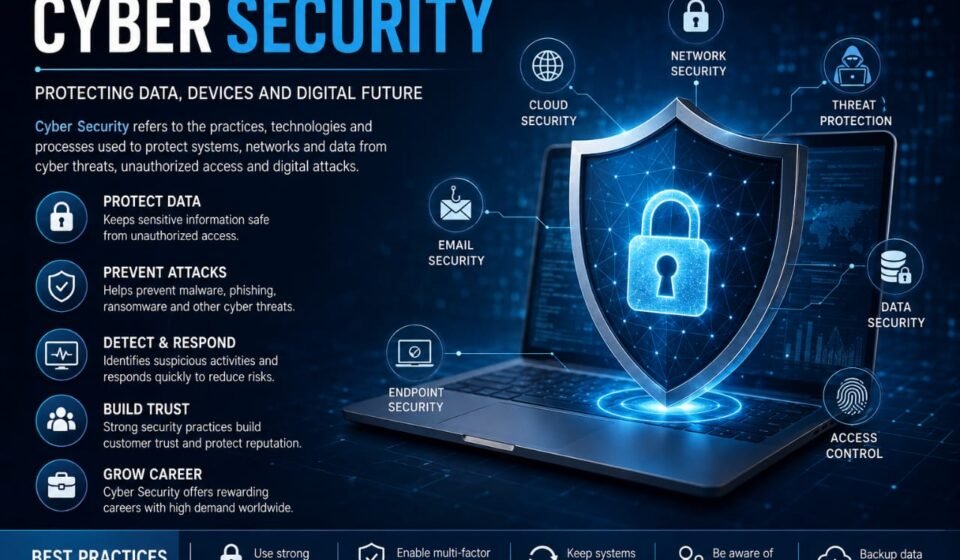

The internet has become an important part of everyday life. People use websites, mobile applications, online banking, social media, email, and digital services for personal and professional activities. As our dependence on technology increases, protecting digital information has become equally important. Cyber Security helps protect computers, networks, applications, devices, and data from unauthorized access, attacks, and other digital threats.
For individuals, Cyber Security can help protect personal information such as passwords, photographs, financial details, and online accounts. For businesses, it can protect customer information, company data, applications, and important digital systems. Understanding basic online security is therefore becoming important for everyone who uses technology.
What Is Cyber Security?
Cyber Security refers to the practices, technologies, processes, and controls used to protect digital systems and information from cyber threats. These threats can include malware, phishing, ransomware, unauthorized access, data theft, and other malicious activities.
In simple words, Cyber Security is about keeping digital information and systems safe. Just as people lock their homes to protect physical belongings, organizations use security technologies and practices to protect their digital assets.
Cybersecurity is not limited to installing antivirus software. It includes many areas such as network protection, application security, data protection, identity management, security monitoring, and employee awareness.
Why Is Cyber Security Important?
The importance of Cyber Security has increased because businesses and individuals now store and share large amounts of information online. A security incident can result in financial losses, privacy problems, operational disruption, and damage to an organization’s reputation.
For businesses, Cyber Security is particularly important because customer information and company data can be valuable targets. A successful attack can interrupt business operations and affect customer trust.
For individuals, strong security practices can reduce the risk of account theft, identity fraud, and unauthorized access to personal information.
Common Cyber Security Threats
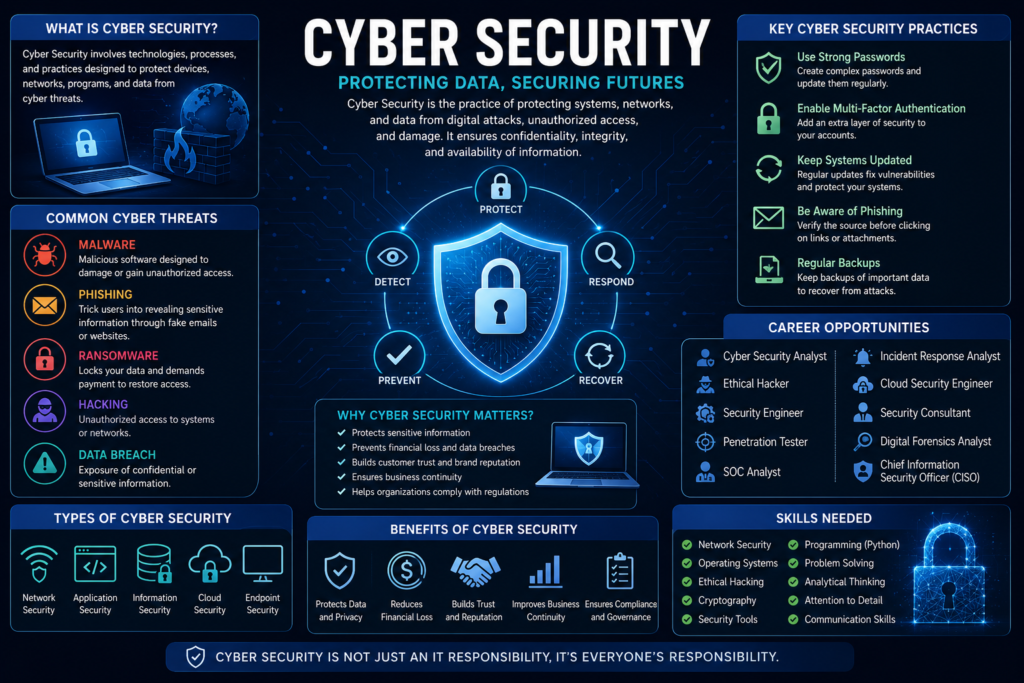
There are many types of threats that individuals and organizations need to understand.
1. Phishing
Phishing is a common type of cyber attack where attackers attempt to trick people into revealing sensitive information. A fraudulent email, message, or website may appear to come from a legitimate company.
Good Cyber Security awareness can help users identify suspicious messages before clicking links or sharing personal information.
2. Malware
Malware is malicious software designed to damage systems, steal information, or perform unauthorized activities. Viruses, worms, trojans, and spyware are examples of malware.
Effective Cyber Security practices such as security software, regular updates, and careful downloading can help reduce exposure to malware.
3. Ransomware
Ransomware is a type of malicious software that can prevent users from accessing files or systems and may demand payment from victims.
Organizations need strong Cyber Security measures, including backups, access controls, monitoring, and security awareness, to reduce the potential impact of ransomware.
4. Password Attacks
Weak or reused passwords can make online accounts easier to compromise. Attackers may use automated methods to guess or obtain passwords.
Using strong and unique passwords is an important part of personal Cyber Security. Multi-factor authentication can provide an additional layer of protection.
5. Social Engineering
Social engineering involves manipulating people into revealing information or performing actions that may compromise security.
This demonstrates why Cyber Security is not only a technical issue. Employees and users also play an important role in protecting digital systems.
Types of Cyber Security
Cyber Security includes several specialized areas. Each area focuses on protecting a different part of the digital environment.
Network Security
Network security focuses on protecting computer networks from unauthorized access, misuse, and attacks. Firewalls, network monitoring, access controls, and security systems can be used to protect network infrastructure.
Strong Cyber Security practices help organizations monitor network activity and respond to suspicious behavior.
Application Security
Application security focuses on protecting software and applications from vulnerabilities and attacks.
Developers can include security practices during the software development process instead of waiting until an application is completed.
This approach makes Cyber Security part of the development lifecycle and can help identify security issues earlier.
Information Security
Information security focuses on protecting information from unauthorized access, modification, disclosure, or destruction.
Organizations need effective Cyber Security controls to protect sensitive business information and customer data.
Cloud Security
As more organizations use cloud services, protecting cloud environments has become increasingly important.
Cloud Cyber Security can involve identity management, encryption, access controls, monitoring, and secure configuration.
Endpoint Security
Computers, smartphones, tablets, and other connected devices can become targets for attackers.
Endpoint Cyber Security focuses on protecting these devices through security software, updates, access controls, and monitoring.
Benefits of Cyber Security
There are many benefits to maintaining strong Cyber Security practices.
Protects Sensitive Information
One of the main benefits of Cyber Security is protecting sensitive information from unauthorized access. This can include personal data, financial information, customer records, and business documents.
Reduces Financial Risk
Cyber attacks can result in financial losses through fraud, operational disruption, data recovery, or other consequences.
Strong Cyber Security measures can help organizations reduce the likelihood and potential impact of security incidents.
Builds Customer Trust
Customers expect businesses to protect their information. Organizations that take Cyber Security seriously can demonstrate that they value customer privacy and data protection.
Supports Business Continuity
A security incident can interrupt important business operations. Backups, monitoring, incident response plans, and other Cyber Security measures can help organizations prepare for potential disruptions.
Protects Reputation
A serious security incident can damage a company’s reputation. Maintaining strong Cyber Security can help reduce the risks associated with data breaches and other attacks.
Cyber Security for Individuals
You do not need to work for a technology company to practice good Cyber Security. Simple habits can make a significant difference.
Use strong and unique passwords for important accounts. Avoid using the same password everywhere because one compromised account could affect multiple services.
Enable multi-factor authentication whenever it is available. This provides an additional verification step beyond the password.
Keep operating systems, applications, browsers, and security software updated. Software updates often include security fixes that address known vulnerabilities.
Be careful when opening unexpected links or attachments. Before sharing personal information, check whether the website or message is legitimate.
These simple habits can improve personal Cyber Security and reduce exposure to common online threats.
Cyber Security in Businesses
Businesses need a more comprehensive approach to Cyber Security because they manage multiple users, devices, applications, networks, and data sources.
Organizations can establish access controls so employees only receive the permissions necessary for their responsibilities. Regular monitoring can help identify unusual activity.
Employee training is also important. Even advanced security systems can be affected by human mistakes, so employees should understand phishing, password security, suspicious links, and safe data handling.
Businesses should also prepare incident response plans. Knowing what to do during a security incident can help reduce confusion and improve the speed of response.
Cyber Security and Digital Marketing
Digital marketing professionals also need to understand Cyber Security because marketing activities involve websites, customer information, email platforms, advertising accounts, analytics tools, and social media accounts.
A compromised marketing account can affect campaigns, customer communication, website content, or advertising budgets.
Digital marketers should use strong passwords, multi-factor authentication, appropriate account permissions, and secure access practices.
Website security is also important for SEO and user trust. A secure website helps provide a safer experience for visitors and protects the website from certain types of attacks.
Cyber Security and Artificial Intelligence
Artificial intelligence is becoming increasingly connected with Cyber Security. Security teams can use intelligent systems to analyze large amounts of activity and identify unusual patterns.
AI can help security professionals detect suspicious behavior, prioritize alerts, and support faster analysis.
At the same time, attackers can also use advanced technologies to create more convincing phishing messages or automate certain malicious activities.
This means the future of Cyber Security will involve both technological innovation and continuous improvement in security practices.
Career Opportunities in Cyber Security
The growing number of cyber threats has increased the demand for professionals with security knowledge and skills.
Some common Cyber Security career roles include:
- Cyber Security Analyst
- Security Engineer
- Security Administrator
- Network Security Engineer
- Security Consultant
- Penetration Tester
- Security Operations Center Analyst
- Incident Response Analyst
- Cloud Security Engineer
- Application Security Engineer
- Cyber Security Manager
Students interested in these careers can begin by learning computer networks, operating systems, Linux, basic programming, databases, and security fundamentals.
Practical experience is extremely useful. Beginners can create small security projects, practice in legal cybersecurity labs, and learn how different security tools work.
Skills Needed for a Cyber Security Career
A successful career in Cyber Security requires a combination of technical knowledge, problem-solving ability, and continuous learning.
Networking is one of the most important foundations. Beginners should understand concepts such as IP addresses, protocols, ports, firewalls, and network communication.
Knowledge of operating systems, especially Linux and Windows, is also valuable.
Basic programming can help security professionals understand applications and automate repetitive tasks. Python is commonly used for scripting and automation.
Communication skills are also important because security professionals often need to explain technical risks to people who may not have a technical background.
Challenges in Cyber Security
Although Cyber Security provides strong protection, it is not a one-time activity. New threats and vulnerabilities continue to appear as technology develops.
Organizations need to regularly update systems, review access permissions, monitor networks, train employees, and test security controls.
Another challenge is the shortage of skilled cybersecurity professionals. As organizations become more dependent on technology, the need for people who understand digital security is likely to continue.
Balancing security with convenience can also be difficult. Strong security controls should protect users without unnecessarily making systems difficult to use.
Future of Cyber Security
The future of Cyber Security will be influenced by technologies such as artificial intelligence, cloud computing, automation, Internet of Things devices, and increasingly connected digital systems.
As more devices connect to the internet, the number of potential security points can increase. Organizations will need stronger identity management, monitoring, authentication, and data protection.
Cloud environments will also continue to require careful security management as businesses move more applications and workloads online.
For students and professionals, continuous learning will be essential. Security techniques that are effective today may need to evolve as new technologies and threats emerge.