

Technology is changing faster than ever, and one of the biggest reasons behind this change is Artificial Intelligence. From the recommendations we see on social media to voice assistants, online shopping, healthcare, banking, and education, AI is becoming part of everyday life. Many people use AI-powered tools without even realizing how much technology is working behind the scenes.
Artificial Intelligence is helping businesses work faster, automate repetitive tasks, understand customer needs, and make better decisions. At the same time, it is creating new opportunities for students, professionals, and businesses. Understanding AI today can help people prepare for the technology-driven future.
What Is Artificial Intelligence?
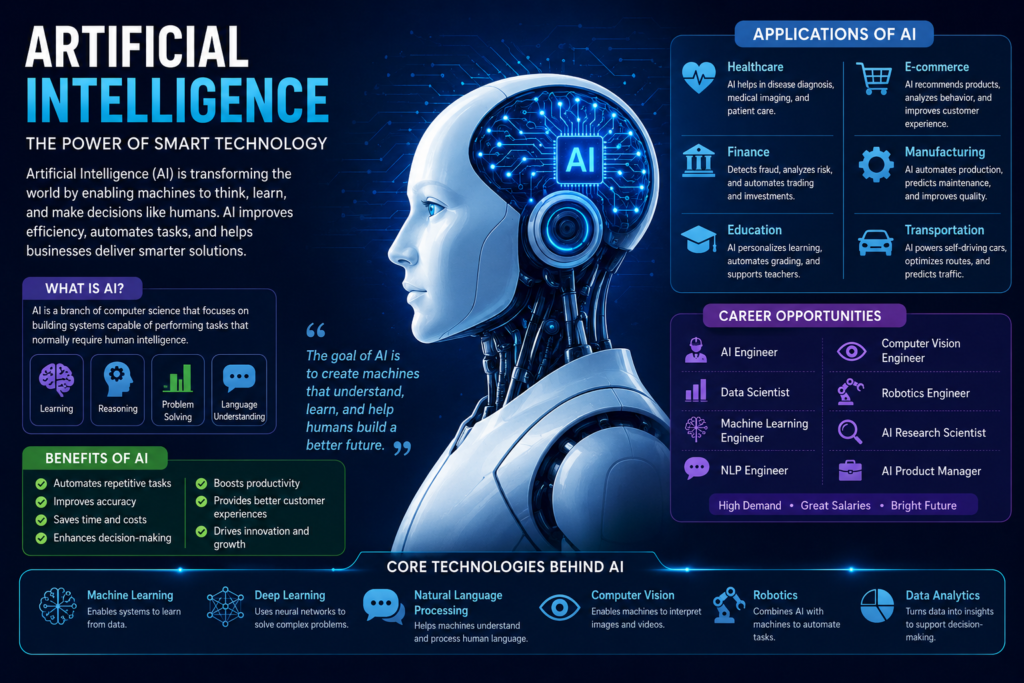
Artificial Intelligence is a technology that allows computers and machines to perform tasks that normally require human intelligence. These tasks can include learning from information, understanding language, recognizing images, identifying patterns, solving problems, and making decisions.
In simple words, AI helps machines learn from data and respond intelligently instead of following only fixed instructions.
For example, when you ask a voice assistant a question, it understands your words and provides an answer. When an online shopping website recommends products based on your previous searches, AI is working in the background. Similarly, when your phone recognizes your face to unlock the screen, AI technology is involved.
The goal of AI is not simply to make machines intelligent. It is also about helping people complete tasks more efficiently and solve problems that may require large amounts of information.
Why Is Artificial Intelligence Important?
The importance of Artificial Intelligence is growing because businesses and individuals generate huge amounts of data every day. Manually analyzing all this information can take a lot of time and effort.
AI can process large amounts of data quickly and identify useful patterns. This allows businesses to understand their customers, improve their services, reduce unnecessary costs, and make faster decisions.
For example, a retail company can use AI to understand which products customers are interested in. A hospital can use intelligent systems to support doctors in analyzing medical information. A bank can use AI to identify unusual transactions and improve security.
AI is therefore becoming an important part of modern technology across different industries.
How Does Artificial Intelligence Work?
AI systems work by using data, algorithms, and computing power. A machine is trained using information so that it can identify patterns and provide useful results.
One important area of AI is machine learning. Instead of programming a computer with every possible instruction, machine learning allows systems to learn from examples and improve their performance over time.
For instance, imagine a system that needs to identify whether an email is spam. The system can be trained using thousands of examples of spam and genuine emails. By studying these examples, it can learn common patterns and predict whether a new email is likely to be spam.
Another area is natural language processing, which helps computers understand and respond to human language. This technology is used in chatbots, translation applications, search engines, and voice assistants.
Common Examples of AI in Everyday Life
You do not need to work in a technology company to experience AI. It is already present in many everyday activities.
1. Voice Assistants
Voice assistants can understand spoken commands and respond to questions. They can help users search for information, set reminders, play music, or control smart devices.
2. Online Shopping
E-commerce platforms use AI to recommend products based on searches, previous purchases, and browsing behavior. These recommendations can make shopping more personalized.
3. Social Media
Social media platforms use AI algorithms to decide which posts, videos, advertisements, and recommendations appear in a user’s feed.
4. Maps and Navigation
Navigation applications analyze traffic conditions, road information, and travel patterns to suggest suitable routes and estimated travel times.
5. Customer Support
Many companies use AI-powered chatbots to answer common customer questions. This allows customers to receive quick responses while support teams can focus on more complex problems.
6. Smartphones
Face recognition, camera improvements, voice typing, spam detection, and personalized recommendations are examples of intelligent features available on modern smartphones.
Benefits of Artificial Intelligence
Artificial Intelligence provides several benefits for businesses and individuals.
Faster Work
AI can automate repetitive tasks and complete certain processes much faster than manual methods. This can save time and allow employees to focus on more important responsibilities.
Better Decision-Making
AI can analyze large amounts of information and identify patterns that may be difficult for humans to notice. Businesses can use these insights to make more informed decisions.
Automation
One of the biggest advantages of AI is automation. Repetitive activities such as sorting information, responding to common questions, and organizing data can be automated.
Personalized Experiences
AI can understand user behavior and provide personalized recommendations. This is commonly seen in shopping platforms, entertainment applications, and social media.
Improved Productivity
When machines handle repetitive tasks, employees can spend more time on creative thinking, communication, planning, and problem-solving.
24/7 Availability
AI-powered systems can operate continuously without requiring regular working hours. This can be particularly useful for customer support and online services.
Artificial Intelligence in Different Industries
AI is not limited to one particular field. It is being used across many industries.
Healthcare
Healthcare organizations can use AI to analyze medical information, support research, assist with diagnosis, and improve administrative processes. AI can help healthcare professionals work with large amounts of information more efficiently.
Education
Educational platforms can use AI to provide personalized learning experiences. Students may receive recommendations based on their learning progress, strengths, and areas that require improvement.
Banking and Finance
Banks use AI for fraud detection, customer support, risk analysis, and transaction monitoring. Intelligent systems can identify unusual patterns and help financial organizations improve security.
Retail
Retail businesses use AI to understand customer behavior, manage inventory, recommend products, and improve marketing campaigns.
Manufacturing
Manufacturing companies can use AI to monitor equipment, identify potential problems, improve production processes, and reduce downtime.
Marketing
Digital marketers are increasingly using AI for content ideas, customer analysis, campaign optimization, data interpretation, and personalization. However, human creativity and judgment remain important for producing useful and trustworthy marketing content.
Artificial Intelligence and Digital Marketing
AI is becoming especially useful in digital marketing. Marketers deal with large amounts of customer data, website information, search behavior, social media activity, and advertising results.
AI tools can help marketers analyze this information and identify patterns. They can also support keyword research, audience analysis, content planning, customer segmentation, and campaign optimization.
For example, a marketer can study customer behavior to understand what type of content attracts visitors. Advertising platforms can also use intelligent algorithms to identify audiences that are more likely to respond to a particular advertisement.
However, marketers should not depend completely on automated tools. Good digital marketing still requires creativity, strategy, human understanding, research, and knowledge of the target audience.
Career Opportunities in Artificial Intelligence
The growth of AI is creating opportunities for people interested in technology. Students who build strong technical and problem-solving skills can explore different career paths.
Some AI-related roles include:
- AI Engineer
- Machine Learning Engineer
- Data Scientist
- Data Analyst
- AI Researcher
- Natural Language Processing Engineer
- Computer Vision Engineer
- Robotics Engineer
- AI Product Manager
- Machine Learning Specialist
People interested in these careers can begin by learning basic programming, mathematics, statistics, data analysis, and machine learning concepts. Python is also widely used in many AI and data-related projects.
Skills Needed to Learn AI
You do not need to learn everything at once. Beginners can build their knowledge gradually.
Start with basic programming concepts, especially Python. After that, learn mathematics and statistics that are useful for data analysis. You can then move toward machine learning, data visualization, and AI concepts.
Practical projects are also important. Instead of only watching tutorials, try building small projects. For example, you could create a simple recommendation system, chatbot, image classification project, or data prediction model.
Learning continuously is important because technology changes rapidly.
Challenges of Artificial Intelligence
Although AI provides many benefits, it also creates challenges.
One concern is data privacy. AI systems often require large amounts of information, so organizations need to handle user data responsibly.
Another challenge is accuracy. AI systems can sometimes produce incorrect or misleading results. Human review is important, especially when AI is used for important decisions.
There are also concerns about changes in employment. Automation may reduce the need for some repetitive tasks while creating demand for new technology-related skills. Instead of viewing AI only as a replacement for human work, it is useful to understand how people can work together with intelligent tools.
Ethical use is another important consideration. Organizations should use AI responsibly, transparently, and fairly.
The Future of Artificial Intelligence
The future of Artificial Intelligence is likely to bring even more changes to the way people work and interact with technology.
AI may become more integrated into education, healthcare, transportation, entertainment, business, and communication. Companies will continue looking for ways to automate processes and provide better customer experiences.
At the same time, human skills will remain valuable. Creativity, critical thinking, communication, emotional understanding, leadership, and decision-making are difficult to replace completely.
The future is therefore not simply about humans versus machines. It is increasingly about how people can use technology effectively while maintaining human judgment and responsibility.