
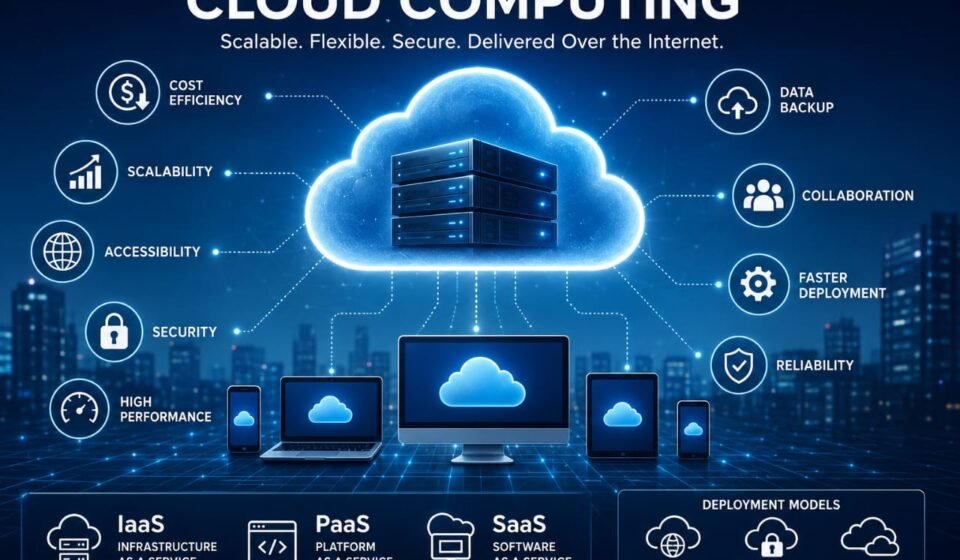

Technology is changing the way people work, communicate, store information, and run businesses. One of the most important developments in modern technology is Cloud Computing. Instead of depending completely on physical computers and local storage, people and businesses can access computing resources through the internet. From storing photos and files to running large business applications, Cloud Computing has become an important part of everyday digital life.
What Is Cloud Computing?
Cloud Computing is a technology that allows users to access computing resources such as storage, servers, databases, software, and applications through the internet. Instead of purchasing and maintaining expensive physical infrastructure, businesses can use resources provided by cloud service providers.
For example, when you save a document using an online storage service, you may be using Cloud Computing without realizing it. The file is stored on remote servers and can be accessed from different devices whenever an internet connection is available.
This approach makes technology more flexible because users do not always need powerful hardware or large amounts of local storage. They can access the resources they need when required.
How Does Cloud Computing Work?
The basic idea behind Cloud Computing is simple. Cloud providers operate large data centers containing servers, storage systems, networking equipment, and other computing infrastructure. These resources are made available to customers through the internet.
When a customer needs additional storage or computing power, the provider can allocate the required resources. This means a company does not necessarily have to purchase new physical servers every time its business grows.
Cloud platforms also use technologies such as virtualization to divide physical resources into multiple virtual environments. This helps providers manage resources efficiently and serve many customers at the same time.
Why Is Cloud Computing Important?
The importance of Cloud Computing has increased as businesses have become more dependent on digital services. Companies need reliable systems for storing information, running applications, communicating with customers, and managing operations.
Traditional IT infrastructure can require significant investment in hardware, maintenance, electricity, security, and technical support. Cloud services can provide businesses with an alternative approach in which computing resources can be accessed according to their requirements.
For small businesses and startups, this can be particularly useful because they may be able to start with a smaller amount of infrastructure and increase their usage as the business grows.
Benefits of Cloud Computing
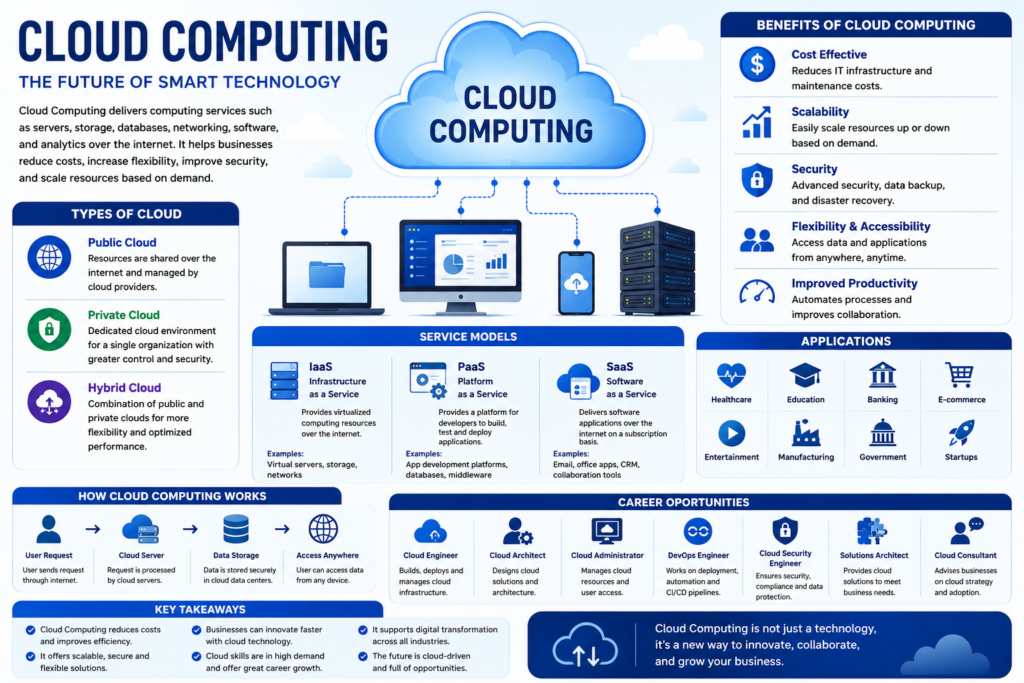
There are several reasons why Cloud Computing has become popular among businesses and individual users.
1. Cost Efficiency
One major benefit of Cloud Computing is that organizations can reduce the need to purchase and maintain large amounts of physical hardware. Instead, they can pay for the cloud resources they use according to their chosen service model.
This can help businesses manage technology budgets more effectively. However, cloud costs still need to be monitored because unnecessary resources and poor configuration can increase expenses.
2. Scalability
Businesses do not always have the same computing requirements. A website may receive a normal amount of traffic on most days but experience a significant increase during a major sale.
With Cloud Computing, organizations can increase or decrease resources according to demand. This flexibility can be useful for businesses experiencing rapid growth or changing workloads.
3. Accessibility
Cloud Computing allows users to access applications and information from different locations and devices, provided they have appropriate permissions and internet connectivity.
This has become especially useful for teams working remotely or across multiple offices. Employees can collaborate on digital files and applications without always being connected to the same physical network.
4. Data Backup
Cloud services can support data backup and recovery strategies. Businesses can store copies of important information in cloud environments to reduce the risk of losing data because of hardware failure or other technical problems.
However, organizations should still have proper backup policies rather than assuming that every cloud service automatically provides complete protection.
5. Faster Deployment
Cloud platforms can allow businesses to create and deploy computing resources more quickly than traditional infrastructure in many situations.
A development team can set up an environment for testing an application without waiting for physical hardware to be purchased and installed.
6. Improved Collaboration
Modern businesses often have employees working from different locations. Cloud Computing can support collaboration by allowing teams to access shared applications, documents, and services.
This can make communication and teamwork easier, particularly for organizations with distributed teams.
Types of Cloud Computing
There are different ways to classify Cloud Computing services. The three commonly discussed service models are Infrastructure as a Service, Platform as a Service, and Software as a Service.
Infrastructure as a Service
Infrastructure as a Service, or IaaS, provides fundamental computing resources such as virtual machines, networking, and storage.
Organizations can use these resources to build and operate their own applications and systems without managing the underlying physical hardware.
Platform as a Service
Platform as a Service, or PaaS, provides an environment where developers can build, test, and deploy applications.
It reduces the amount of infrastructure management required from developers, allowing them to concentrate more on application development.
Software as a Service
Software as a Service, or SaaS, provides software applications through the internet. Users generally access these applications through a web browser or dedicated application.
Email platforms, online office applications, customer relationship management systems, and many business applications can use the SaaS model.
Types of Cloud Deployment
Cloud environments can also be categorized according to how they are deployed.
Public Cloud
A public cloud provides computing resources through a cloud provider’s infrastructure. Multiple customers can use the provider’s services while their resources and data remain logically separated.
Public cloud environments are widely used because they can provide flexible resources without requiring businesses to operate their own physical data centers.
Private Cloud
A private cloud is designed for use by a single organization. It can provide greater control over infrastructure and configuration, depending on how it is implemented.
Organizations with specific security, compliance, or operational requirements may consider private cloud approaches.
Hybrid Cloud
A hybrid cloud combines private infrastructure with public cloud resources. Businesses can use different environments depending on their application requirements.
For example, an organization may keep certain workloads in a private environment while using public cloud resources for applications that require additional scalability.
Cloud Computing in Everyday Life
Many people use Cloud Computing every day without thinking about the technology behind it.
Online photo storage, video streaming, email, online document editing, mobile applications, and file-sharing services can depend on cloud infrastructure.
When you watch a video online, you do not normally download the entire service to your computer before watching it. Instead, the content can be delivered through internet-connected infrastructure.
Similarly, when you access your email from different devices, your messages are stored and managed through online systems rather than only on your personal computer.
Cloud Computing in Business
Businesses across industries use Cloud Computing for different purposes. Retail companies can use cloud systems to manage websites, inventory, customer information, and online orders.
Banks and financial organizations can use cloud technologies for selected applications, data processing, analytics, and digital services while following appropriate security and regulatory requirements.
Healthcare organizations can use cloud platforms for applications, data management, collaboration, and research, depending on their regulatory and security needs.
Educational institutions can also use cloud-based platforms for online learning, collaboration, digital classrooms, and administration.
Cloud Computing and Digital Marketing
For digital marketers, understanding Cloud Computing can be useful because modern marketing depends heavily on digital platforms and data.
Websites, analytics platforms, customer relationship systems, advertising tools, email marketing platforms, and content management systems may depend on cloud infrastructure.
Cloud technology can help businesses manage large amounts of website traffic and marketing data. It can also support tools that marketers use to understand customer behavior and measure campaign performance.
For someone learning digital marketing, basic knowledge of cloud technology can therefore provide a better understanding of how modern websites and digital platforms operate.
Cloud Security
Security is one of the most important considerations when using Cloud Computing. Businesses may store valuable information and operate important applications through cloud platforms, so protecting these systems is essential.
Cloud security can involve identity management, access controls, encryption, monitoring, network security, and regular security updates.
Users should also follow good security practices. Strong passwords, multi-factor authentication, appropriate permissions, and regular security reviews can help reduce unnecessary risks.
Cloud providers can provide security infrastructure, but customers are still responsible for securing the parts of the environment that they control. This is often described through a shared responsibility approach.
Challenges of Cloud Computing
Although Cloud Computing offers many benefits, it also has challenges.
Internet connectivity can affect access to cloud services. If an organization experiences network problems, employees may have difficulty accessing certain cloud-based applications.
Cost management can also become challenging. If businesses create unnecessary resources or fail to monitor usage, their monthly cloud bills may increase.
Security and privacy are additional concerns. Organizations need to understand where their data is stored, who can access it, and how their cloud provider handles security.
There can also be concerns about dependence on a particular cloud provider. Moving applications and data between different platforms may require planning and technical effort.
Cloud Computing Career Opportunities
The growth of Cloud Computing has created several career opportunities in the technology industry.
Some popular roles include:
- Cloud Engineer
- Cloud Architect
- Cloud Administrator
- Cloud Security Engineer
- DevOps Engineer
- Cloud Developer
- Solutions Architect
- Site Reliability Engineer
- Cloud Consultant
- Cloud Support Engineer
People interested in cloud careers can begin by learning networking, operating systems, databases, security fundamentals, and basic programming.
After learning the fundamentals, beginners can explore major cloud platforms and practice creating simple cloud-based projects.
Skills Needed for a Cloud Career
A career in Cloud Computing requires both technical knowledge and practical experience.
Beginners can start with networking fundamentals, Linux basics, virtualization concepts, databases, and security.
Learning a programming language such as Python can also be helpful. Knowledge of automation, containers, version control, and DevOps practices can further improve career opportunities.
Practical projects are extremely valuable. Instead of only watching tutorials, students can create small applications, deploy websites, configure cloud storage, or experiment with virtual machines.
Certifications can also be useful for demonstrating knowledge, but practical skills and understanding are equally important.
Future of Cloud Computing
The future of Cloud Computing is closely connected with the growth of artificial intelligence, machine learning, big data, automation, and digital businesses.
As organizations generate more data and use more online applications, demand for scalable computing infrastructure is likely to continue.
Technologies such as edge computing, serverless computing, containers, and cloud-native development are also influencing how applications are built and delivered.
Businesses are likely to focus not only on moving applications to the cloud but also on using cloud infrastructure efficiently, securely, and responsibly.